





Teresa Amabile
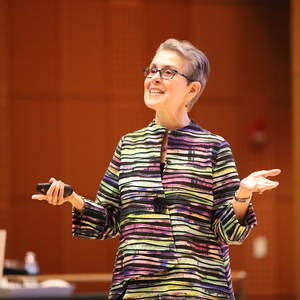
Teresa Amabile is the Edsel Bryant Ford Professor of Business Administration and a Director of Research at Harvard Business School. Dr. Amabile's research originally focused on individual creativity and has since expanded to encompass team creativity and organizational innovation. This 35-year program of research on how the work environment can influence creativity and motivation has yielded a theory of creativity and innovation; methods for assessing creativity, motivation, and the work environment; and a set of prescriptions for maintaining and stimulating innovation.
Dr. Amabile has presented her creativity theory, her research results, and her methods for stimulating innovation to various groups in business, government, and education, including Lucent Technologies, Procter & Gamble Company, and Novartis International AG. In addition to participating in various executive programs, her main teaching assignment at Harvard Business School is the MBA course, Leadership and Organizational Behavior. Moreover, she created the elective MBA course, Managing for Creativity. Dr. Amabile was the host/instructor of "Against All Odds: Inside Statistics," a 26-part instructional series originally produced for broadcast on PBS, and in 1998 she was awarded the E. Paul Torrance Award by the Creativity Division of the National Association for Gifted Children in 1998.
Most recently, Dr. Amabile has been directing a multi-study research program that extends her earlier findings on how the work environment affects creativity. This research initiative has identified specific daily events in organizations that influence the perceptions, emotions, motivation, and, ultimately, performance of individuals and teams expected to produce creative outcomes. The longitudinal data collection tracked a number of projects in which creativity was both possible and desirable. The research program's findings have been reported in both management publications and scholarly journals, and provide the basis for a number of teaching cases on entrepreneurial behavior within organizations. A book for business practitioners, currently in progress, summarizes the findings and their practical application.
Dr. Amabile is the author of "Creativity in Context" and "Growing Up Creative," as well as more than 150 scholarly papers, chapters, case studies, and presentations. She serves on the editorial boards of Creativity Research Journal, Creativity and Innovation Management, and the Journal of Creative Behavior.
Primary Interests:
- Applied Social Psychology
- Emotion, Mood, Affect
- Motivation, Goal Setting
- Organizational Behavior
Note from the Network: The holder of this profile has certified having all necessary rights, licenses, and authorization to post the files listed below. Visitors are welcome to copy or use any files for noncommercial or journalistic purposes provided they credit the profile holder and cite this page as the source.
Image Gallery

Video Gallery

The Progress Principle (TEDx talk)
Select video to watch
-
18:37 The Progress Principle (TEDx talk)
Length: 18:37
-
45:29 The Progress Principle (Talks at Google)
Length: 45:29
-
9:45 Answering Questions About the Progress Principle
Length: 9:45
-
12:32 On Creativity and Motivation (Brainwaves Video Anthology)
Length: 12:32
-
21:10 Track Your Small Wins to Motivate Big Accomplishments
Length: 21:10
-
53:21 Organizational Behavior Lifetime Achievement Award Address
Length: 53:21
Presented by the Organizational Behavior Division of the Academy of Management
-
3:15 On Fostering a Creative Work Environment (interview by Dan Goleman)
Length: 3:15
-
59:09 Dissecting Creativity: An Interview with Teresa Amabile
Length: 59:09
-
1:09 What Managers Can Do to Support Creativity and Innovation
Length: 1:09
-
4:14 What Makes People Happy, Motivated, Productive, and Creative at Work?
Length: 4:14
-
38:47 The Progress Principle (Creative Education Foundation)
Length: 38:47
-
3:14 On Management and the Disengagement Crisis (interview by Professor Karl Moore)
Length: 3:14
-
33:58 Keynote Address at APA's 2014 Psychologically Healthy Workplace Awards
Length: 33:58
-
1:14:46 Inner Work Life, Performance, and Managerial Action
Length: 1:14:46
-
1:03:40 Labor of Love: Lessons in Keeping Creativity Alive
Length: 1:03:40
Hosted by the Center for Positive Organizations, Ross School of Business, University of Michigan
Additional Videos
Books:
- Amabile, T. M. (1996). Creativity in context. Boulder, CO: Westview Press.
- Amabile, T. M. (1989). Growing up creative: Nurturing a lifetime of creativity. New York: Crown Publishing Group.
Journal Articles:
- Amabile, T., Constance N. H., & Steven J. K. (2002). Creativity under the gun. Harvard Business Review, 80(8), 52-61.
- Amabile, T. M. (2001). Beyond talent: John Irving and the passionate craft of creativity. American Psychologist, 56(4), 333-336.
- Amabile, T. M. (1998). How to kill creativity. Harvard Business Review, 76(5), 76-87.
- Amabile, T. M. (1990). Cataloguing creativity. Contemporary Psychology, 35, 451.
- Amabile, T. M., Barsade, S. G., Mueller, J. S., & Staw, B. M. (2005). Affect and creativity at work. Administrative Science Quarterly, 50(3), 367-403.
- Amabile, T. M., & Conti, R. (1999). Changes in the work environment for creativity during downsizing. Academy of Management Journal, 42, 630-640.
- Amabile, T. M., Hill, K. G., Hennessey, B. A., & Tighe, E. M. (1994). The work preference inventory: Assessing intrinsic and extrinsic motivational orientations. Journal of Personality and Social Psychology, 66, 950-967.
- Amabile, T. M., & Kramer, S. J. (2007). Inner work life: The hidden subtext of business performance. Harvard Business Review, 85(5), 72-83.
- Amabile, T. M., Patterson, C., Mueller, J., Wojcik, T., Odomirok, P., Marsh, M., & Kramer, S. (2001). Academic-practitioner collaboration in management research: A case of cross-profession collaboration. Academy of Management Journal, 44(2), 418-431.
- Amabile, T. M., Schatzel, E. A., Moneta, G. B., & Kramer, S. J. (2004). Leader behaviors and the work environment for creativity: Perceived leader support. The Leadership Quarterly, 15(1), 5-32.
Other Publications:
- Amabile, T. M., & Mueller, J. S. (2008). Studying creativity, its processes, and its antecedents: An exploration of the componential theory of creativity. In J. Zhou & C. E. Shalley (Eds.), Handbook of Organizational Creativity. New York: Lawrence Erlbaum Associates.
- Fisher, C. & Amabile, T. M. (2009). Creativity, improvisation, and organizations. In T. Rickards, M. A. Runco, & S. Moger (Eds.), The Routledge Companion to Creativity. Oxford, UK: Routledge.
- Hennessey, B. A., & Amabile, T. M. (2010). Creativity. Chapter in S. T. Fiske (Ed.), Annual Review of Psychology, 61, 569-598. Palo Alto, CA: Annual Reviews.
Teresa Amabile
Harvard Business School
Rock Center
Soldiers Field
Boston, Massachusetts 02163
United States of America
- Phone: (617) 495-6871
- Fax: (617) 496-4877
